Vasovagal Syncope: Why You Faint and What You Can Do About It
A cardiologist's plain-language guide to vasovagal syncope—why people faint, the warning signs, what to do in the moment, counter-pressure maneuvers, tilt-table testing, and when fainting is a red flag.


Have you ever felt suddenly hot, nauseated, sweaty, or lightheaded—and then realized you might pass out?
That pattern is often caused by vasovagal syncope, the most common type of fainting.
The name sounds complicated, but the basic idea is simple: the nervous system briefly overreacts, blood pressure drops, and the brain does not receive enough blood to keep you awake.
The episode is usually brief. The bigger concern is often not the faint itself, but where and when it happens.
Here are the questions patients ask most often.
What exactly is vasovagal syncope?
Syncope is the medical term for a brief loss of consciousness caused by reduced blood flow to the brain.
It can happen after standing too long, becoming overheated, seeing blood, having blood drawn, feeling pain, becoming dehydrated, or experiencing a strong emotional reaction.
Some people have a clear trigger every time. Others do not.
What happens in the body when someone faints?
When you stand up, gravity pulls blood toward your legs and abdomen.
Normally, your nervous system responds within seconds. The blood vessels tighten, the heart rate adjusts, and enough blood continues to reach the brain.
During a vasovagal episode, that response suddenly goes in the wrong direction.
The blood vessels relax too much. Blood pressure falls. In some people, the heart rate also slows.
For a few seconds, the brain does not receive enough blood, and the person loses consciousness.
Once the person is lying flat, blood can return to the brain more easily. This is why most people wake up fairly quickly.
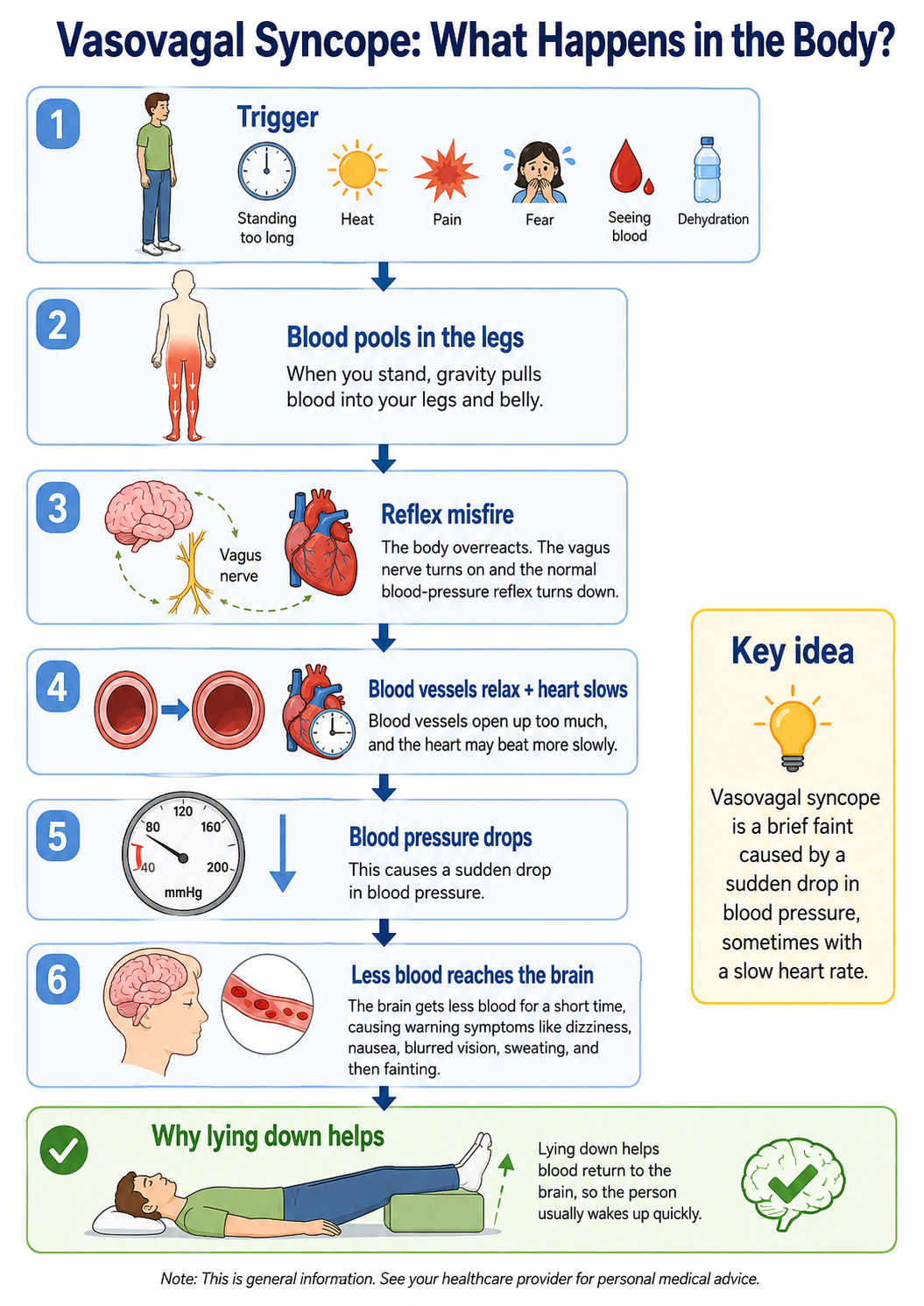
What are the warning signs?
Many people have warning symptoms before they faint. These may include:
- Lightheadedness
- Nausea
- Feeling suddenly hot
- Sweating
- Blurred or tunnel vision
- Ringing in the ears
- Weakness
- Looking pale
- Feeling disconnected or "far away"
These symptoms are useful. They give you a short window to act before you fall.
What should I do when I feel a faint coming?
Lie down immediately.
Do not try to walk to another room. Do not try to make it to the bathroom. Do not stand there hoping the feeling will pass.
Lie flat and raise your legs if you can.
If you cannot lie down, sit on the floor. Getting lower protects you from injury and makes it easier for blood to reach your brain.
What are counter-pressure maneuvers?
Counter-pressure maneuvers are strong muscle contractions that can temporarily raise blood pressure.
Tightening the large muscles in your legs, abdomen, arms, and hands squeezes blood out of the veins and pushes it back toward the heart.
This can improve blood flow to the brain and sometimes stop or delay a faint.
They work best when you have enough warning before losing consciousness.
Leg crossing
Cross one leg firmly over the other.
At the same time, squeeze your calves, thighs, buttocks, and abdominal muscles as tightly as you comfortably can.
Keep breathing normally.
Arm tensing
Clasp your hands together in front of your chest.
Pull your arms in opposite directions without allowing your hands to separate.
Handgrip
Make a tight fist or firmly squeeze a ball or another solid object.
Squatting
If it is safe for your knees and balance, lower yourself into a squat and tighten your leg and abdominal muscles.
Squatting also brings you closer to the ground if the symptoms continue.
If symptoms are getting stronger, stop trying to remain upright and lie down.
Do they actually work?
In a randomized study of people with recurrent vasovagal syncope and recognizable warning symptoms, those taught counter-pressure maneuvers were less likely to faint again than those who received standard advice alone.
A later review found that the maneuvers increased standing systolic blood pressure by an average of about 15 mmHg. They are not perfect, but they are simple, free, and safe for most people.
Practice them before you need them.
A useful way to remember the steps is:
Feel it. Squeeze. Get low.
Watch a demonstration
Why is vasovagal syncope more common in young women?
There is probably more than one reason.
Young women often start with a lower resting blood pressure and a lower circulating blood volume than men. This means that heat, dehydration, prolonged standing, or illness may have a bigger effect.
Hormones may also affect blood-vessel tone and the way the body handles salt and water.
Some women notice that dizziness is worse around their menstrual period. Heavy periods, iron deficiency, or anemia can further lower the body's ability to tolerate standing.
This does not mean that fainting in women is "just hormonal." The physiology is real, and symptoms deserve a proper evaluation.
How is vasovagal syncope diagnosed?
In many patients, the diagnosis comes from the story.
A classic episode usually has:
- A recognizable trigger
- Warning symptoms such as warmth, nausea, sweating, or tunnel vision
- A brief loss of consciousness
- Quick recovery after lying down
- Fatigue afterward
Your clinician will usually review your medications, examine you, check blood pressure lying and standing, and obtain an electrocardiogram.
Further testing depends on the details of the episode and whether there are warning signs of a heart rhythm problem or structural heart disease.
What is a tilt-table test?
A tilt-table test allows clinicians to watch what happens to your heart rate and blood pressure when your body is moved from lying flat to an almost-upright position.
You lie on a padded table and are secured with straps. The table is then tilted upward, usually to around 60 to 80 degrees.
You are not expected to stand using your own muscles. This removes the help normally provided by the leg-muscle pump.
Throughout the test, your heart rhythm, heart rate, blood pressure, and symptoms are monitored.
The goal is to see whether upright posture reproduces your usual symptoms and whether those symptoms occur with:
- A drop in blood pressure
- A slowing of the heart rate
- An excessive rise in heart rate
- Another recognizable pattern
Does everyone who faints need a tilt-table test?
No.
If the history is classic for vasovagal syncope and the initial evaluation is reassuring, a tilt-table test may not add much.
The test is more useful when:
- The diagnosis remains uncertain
- Fainting or near-fainting keeps happening
- Symptoms occur mainly while upright
- Delayed orthostatic hypotension is suspected
- POTS or another form of orthostatic intolerance is being considered
- It is unclear whether an episode is syncope, a seizure, or psychogenic pseudosyncope
- Reproducing the patient's usual symptoms would help confirm the diagnosis
It should be used to answer a specific clinical question—not simply because someone fainted once.
What does a positive tilt-table test mean?
A positive test means that the upright position caused symptoms along with an abnormal heart-rate or blood-pressure response.
For vasovagal syncope, the test may show a major drop in blood pressure, a slowing of the heart rate, or both.
The most useful result is one that reproduces the patient's usual symptoms.
A positive test does not necessarily mean that every future episode will follow exactly the same pattern. It shows that the person is susceptible to an abnormal response during upright stress.
Can the test be negative even if I have vasovagal syncope?
Yes.
A negative test does not completely rule out vasovagal syncope. The body may simply not reproduce the reaction on that particular day.
Hydration, sleep, anxiety, medications, menstrual timing, and other factors may influence the result.
That is why tilt-table testing is interpreted together with the medical history, physical examination, electrocardiogram, and any rhythm monitoring—not by itself.
Is tilt-table testing safe?
Tilt-table testing is generally safe when performed in an appropriate medical setting.
It may cause the same symptoms that brought you to the clinic, including nausea, sweating, dizziness, a drop in blood pressure, or fainting.
If that happens, the table is quickly returned to the flat position so blood flow to the brain can recover.
Some people feel tired or nauseated afterward. Serious complications are uncommon.
The test may not be appropriate for everyone, including some people who are pregnant or who have significant blockages in the arteries supplying the heart or brain. Your clinician will review this beforehand.
Can drinking more water help?
Often, yes.
Many people with vasovagal syncope have fewer symptoms when they maintain a better circulating blood volume.
A common starting goal is at least 2 liters of fluid per day. Some patients may need closer to 3 liters, particularly in hot weather or with exercise.
Drinking roughly 16 to 17 ounces of water before prolonged standing, heat exposure, travel, or another predictable trigger may also help.
These amounts are not appropriate for everyone. People with heart failure, kidney disease, liver disease, significant swelling, or a prescribed fluid restriction should speak with their clinician first.
Should I eat more salt?
Salt helps the body retain water and may support blood pressure.
Some patients with low blood pressure and recurrent vasovagal symptoms benefit from increasing sodium intake.
However, extra salt may not be safe if you have:
- High blood pressure
- Heart failure
- Kidney disease
- Liver disease
- Significant swelling
- Pregnancy-related hypertension
Do not start salt tablets or a very high-salt diet without discussing a specific target with your healthcare professional.
Do Liquid I.V. or Buoy drops help?
They can help some people, but their benefit comes mainly from the water and sodium they provide.
They do not directly "fix" the vasovagal reflex.
A standard Liquid I.V. packet typically provides a meaningful sodium dose—often around 500 mg—along with potassium and, depending on the version, sugar or sweeteners.
Buoy Rescue Drops generally provide less sodium per serving—around 300 mg—but may be an option for someone who prefers a product without sugar. Standard Buoy Hydration Drops contain considerably less sodium and may not be enough for someone who has been specifically advised to increase sodium intake.
Formulas change, so always read the current label.
The right questions are:
- How much sodium is in one serving?
- How much sugar or sweetener does it contain?
- How many servings are you using?
- Has your clinician actually recommended extra sodium?
- Do you have kidney, blood-pressure, heart, or fluid-retention issues?
For a healthy person without a reason to limit sodium, one serving is usually reasonable. Multiple servings every day should be discussed with a healthcare professional.
If you already feel faint, do not remain standing while you finish an electrolyte drink. Lie down first. Hydration is prevention; it is not an emergency maneuver.
What else can I do to prevent episodes?
Try to identify the situations that bring on symptoms.
Helpful habits may include:
- Avoiding prolonged motionless standing
- Shifting your weight or moving your legs while standing
- Taking shorter, cooler showers
- Eating regular meals
- Staying hydrated during travel and hot weather
- Limiting alcohol
- Building exercise tolerance gradually
- Strengthening the legs and core
- Using waist-high compression or an abdominal binder when recommended
- Reviewing medications that lower blood pressure
Never stop a prescription medicine on your own.
What if these measures are not enough?
Patients with frequent, unpredictable, or injurious episodes may need additional treatment.
Midodrine tightens blood vessels and can reduce recurrent fainting in some patients.
Fludrocortisone helps the body retain salt and water. It may help selected patients, although the research results have been mixed.
Both medications can cause side effects and require monitoring.
A pacemaker is rarely needed. It is generally reserved for a small group of usually older patients with severe recurrent fainting and a clearly documented long pause in the heartbeat.
When should fainting be treated as an emergency?
Seek urgent medical attention when fainting:
- Occurs during exercise
- Happens while lying down
- Comes with chest pain or shortness of breath
- Occurs with a sudden racing or irregular heartbeat
- Happens without any warning
- Causes a major injury
- Occurs in someone with known heart disease
- Is followed by prolonged confusion
- Is followed by weakness, trouble speaking, or a severe headache
- Occurs with significant bleeding
- Happens in someone with a family history of sudden unexplained death
A first faint, repeated fainting, or a major change in your usual pattern should be medically evaluated.
The takeaway
Vasovagal syncope happens when the nervous system briefly allows blood pressure to fall too far. Sometimes the heart rate slows as well.
For most patients, the best first steps are not complicated:
Learn your warning signs. Stay hydrated. Ask whether more sodium is appropriate. Practice counter-pressure maneuvers. And when symptoms begin, get low before gravity makes the decision for you.
This article is intended for general education. It does not replace an individual medical evaluation, diagnosis, or treatment plan.
Comments
No comments yet. Be the first to share your thoughts.
Sign in to join the conversation.
Sign In